
Criminal Cases in the Carbon County Courts
Carbon County criminal cases divide by the level of the filed charge. Carbon County Justice Court handles county, Price, Helper, and Wellington class B and class C misdemeanors, infractions, and ordinances. Its counter is in Suite 1600 at 751 East 100 North in Price and answers at 435-636-3289. The state-operated Seventh District Court at 149 East 100 South in Price hears every felony and class A misdemeanor. Its clerk can be reached at 435-264-4640.
The split matters because each clerk holds the official Carbon County court file for cases in that court. A city arrest does not mean a city keeps the criminal docket. Nor does a booking charge decide the court forever. The prosecutor's filed count and severity control the route. Justice Court records cover the consolidated lower-court work, while Seventh District records are Utah Judiciary records. Juvenile matters remain protected rather than appearing in ordinary public results. Court staff can also route a request to the correct file custodian.
Carbon County XChange Case Search
Utah Courts Information XChange is the statewide index for District and Justice Court case data. Carbon County readers can scope a query to the county, the court, or both court levels. Case and citation numbers are not unique across Utah, so a number alone can lead to the wrong file. A name search should be checked against court, birth date when shown, filing date, and charge details before a result is treated as a match.
The official XChange access page shows how remote and courthouse access differ.
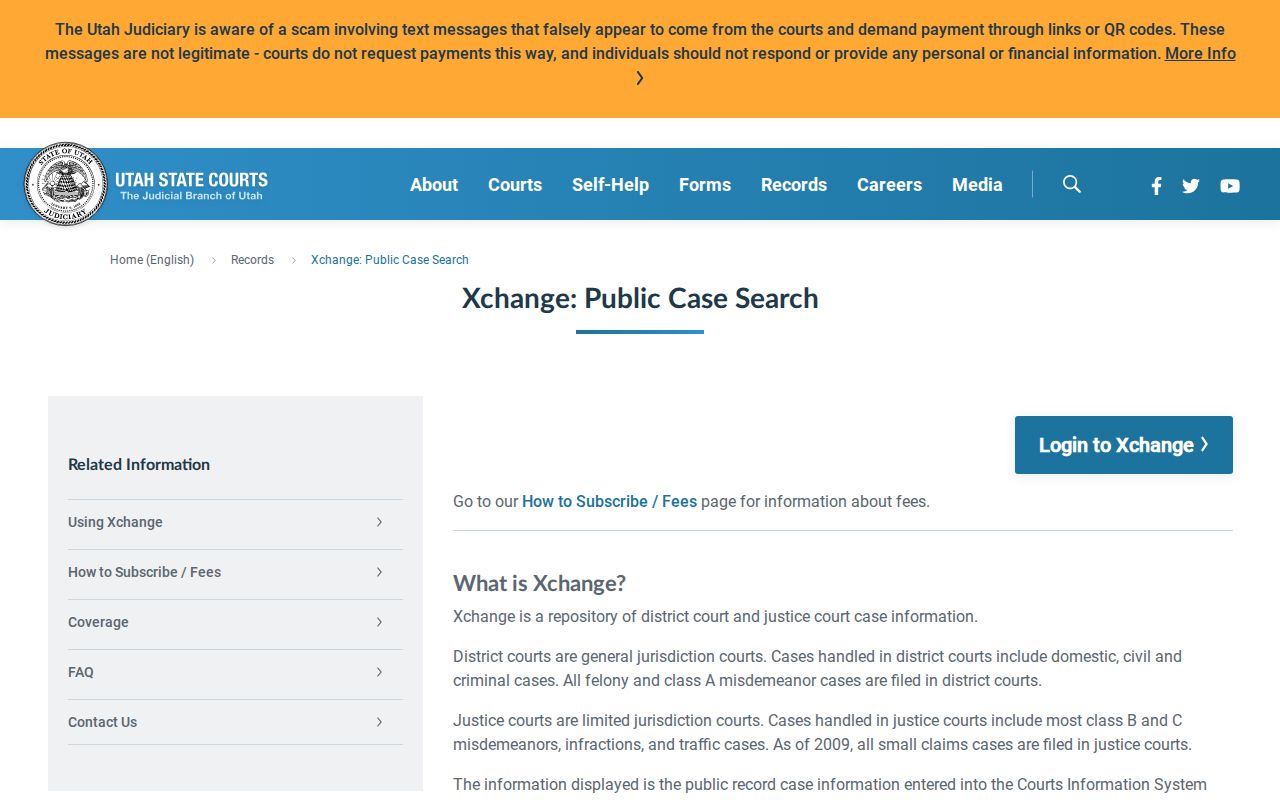
The statewide system links Carbon County's two court levels without turning the jail roster or prosecutor discovery portal into a case search.
How to Search Case Records
Begin with the court that fits the filed offense. Remote XChange subscribers pay a $25 setup fee and $40 per month, including 500 searches. Searches over that allowance cost $0.35, and available public documents cost $1 each. Most district courthouses offer free public XChange terminals, which makes the Seventh District clerk a useful fallback for Carbon County records. Older or document-heavy files may still require direct clerk help.
- Select District, Justice, or both, then limit the scope to Carbon County or the Price court location.
- Enter the case number when known. Otherwise, use last name and first name, with the wildcard only when needed.
- Narrow the Carbon County results by case type, birth date, citation location, or the date-range panel.
- Open the case history and read each count's plea, disposition, events, and financial entries.
- Ask the correct clerk for a public document, an older file, or a copy not offered through XChange.
| Field Label | Type | Required | Notes |
|---|---|---|---|
| Jurisdiction | Selector | No | District, Justice, or both |
| Case Number | Text | No | Not unique statewide |
| Last Name/Company | Text | No | Primary party-name field |
| First Name | Text | No | An asterisk can capture variants |
| Birth Date | Date | No | Useful for narrowing a common name |
| Case Type | Selector | No | Limits the category |
| Search Scope | Selector | No | Statewide, county, or court |
Carbon County Case Codes Decoded
XChange labels can be easy to overread. FS means a State Felony case type. MD means Misdemeanor DUI, MO means Other Misdemeanor, and IF means Infraction. NA can mean no applicable severity, while RC and RN refer to post-conviction relief. A case-type label is not the same as the outcome of every count. Open the history before deciding what happened.
- Arraignment
- The hearing where charges are addressed and a plea is taken.
- Docket
- The chronological list of filings, hearings, and rulings in the Carbon County case.
- Disposition
- The recorded outcome of a charge or the case.
- Plea in abeyance
- A Utah agreement that delays judgment while stated conditions are completed.
- Minute entry
- The court's written record of what occurred at a proceeding.
The official XChange help page illustrates the controls and extended case-history fields.
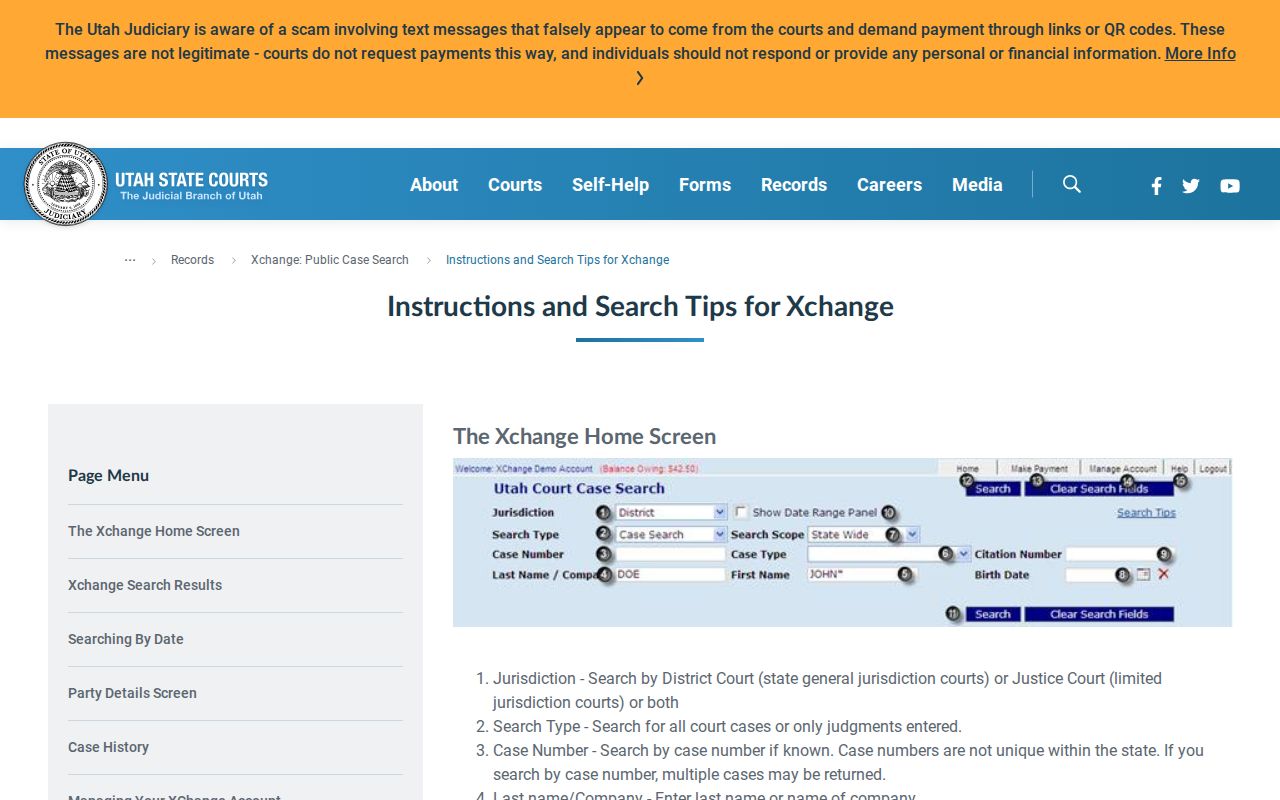
Those field labels help separate a filed count, its plea, and its final disposition instead of treating the first charge description as the result.
What the Case File Shows
A Carbon County court file centers on the filed case, not the arrest narrative. XChange may show the court, caption, case number and type, filing date, status, parties, attorneys, charge descriptions and severity, pleas, dispositions, judge, prosecutor, law-enforcement agency, proceedings, and financial ledgers. Public electronic documents appear only where available. Older converted records may contain less detail.
| Case Number & Court | Identifies the specific Justice or District Court file and its location. |
|---|---|
| Charging Document | Lists prosecutor-filed counts, Utah Code citations, severity, and allegations. |
| Docket Entries | Records filings, orders, minute entries, and other events by date. |
| Hearing Dates | Shows scheduled and completed proceedings when public. |
| Disposition & Judgment | States the count-level outcome, plea or trial result, and judgment. |
| Sentence & Conditions | May show confinement, probation, fines, restitution, and related terms. |
Read the counts one at a time. One count may be dismissed while another ends in conviction. The financial ledger can show assessed, paid, and remaining amounts, but it does not replace the judgment or sentencing entry.
Missing Carbon County Court Records
An empty or sparse result does not always mean no Carbon County case exists. Court-entered data usually reaches XChange promptly, yet older converted files can be thin. A result set is capped at 500, and a broad statewide name query can hide the useful result in noise. Tighten the county and court scope first. Then contact the clerk if the public index lacks an expected event or document.
For a lower matter, use the Carbon County Justice Court counter. For a felony or class A matter, use the Seventh District clerk. Free courthouse terminal access can confirm whether the gap is tied to a remote account view. A party may use MyCase for their own eligible matter, but MyCase is not a public dossier service. Pending criminal discovery also follows counsel and prosecutor procedures rather than a GRAMA request.
Stages of a Criminal Case
After law enforcement sends a case for review, the Carbon County Attorney decides what to file under its published charging policy. The office looks for probable cause, proof that could meet the trial standard, and the interests of justice. Filed lower charges move to Justice Court. Class A misdemeanors and felonies move to Seventh District Court. An arraignment addresses the charges and plea, pretrial work handles motions and negotiations, and the matter then reaches a plea, trial, dismissal, or other disposition.
Case flow: Charges Filed › Arraignment › Pretrial › Plea or Trial › Disposition › Sentencing
The sequence is more accurate than reading a booking entry as the first court event. A booking can occur before any prosecutor-filed count exists, and the final Carbon County charge may differ from the holding allegation.
Carbon County Remote Court Access
Carbon County's lower court publishes a practical remote-hearing route. First appearances are held on Tuesdays at 9 a.m., and most hearings can occur by video or phone. The Webex link appears on the calendar within 24 hours. Tuesday matters are first-come, first-served. Mobile users should install Webex and join 15 minutes early. Interpreter requests should be made five days ahead when possible, while ADA aid or accommodation should be requested at least three working days ahead.
The Carbon County court calendar instructions show the remote-hearing and accessibility process.
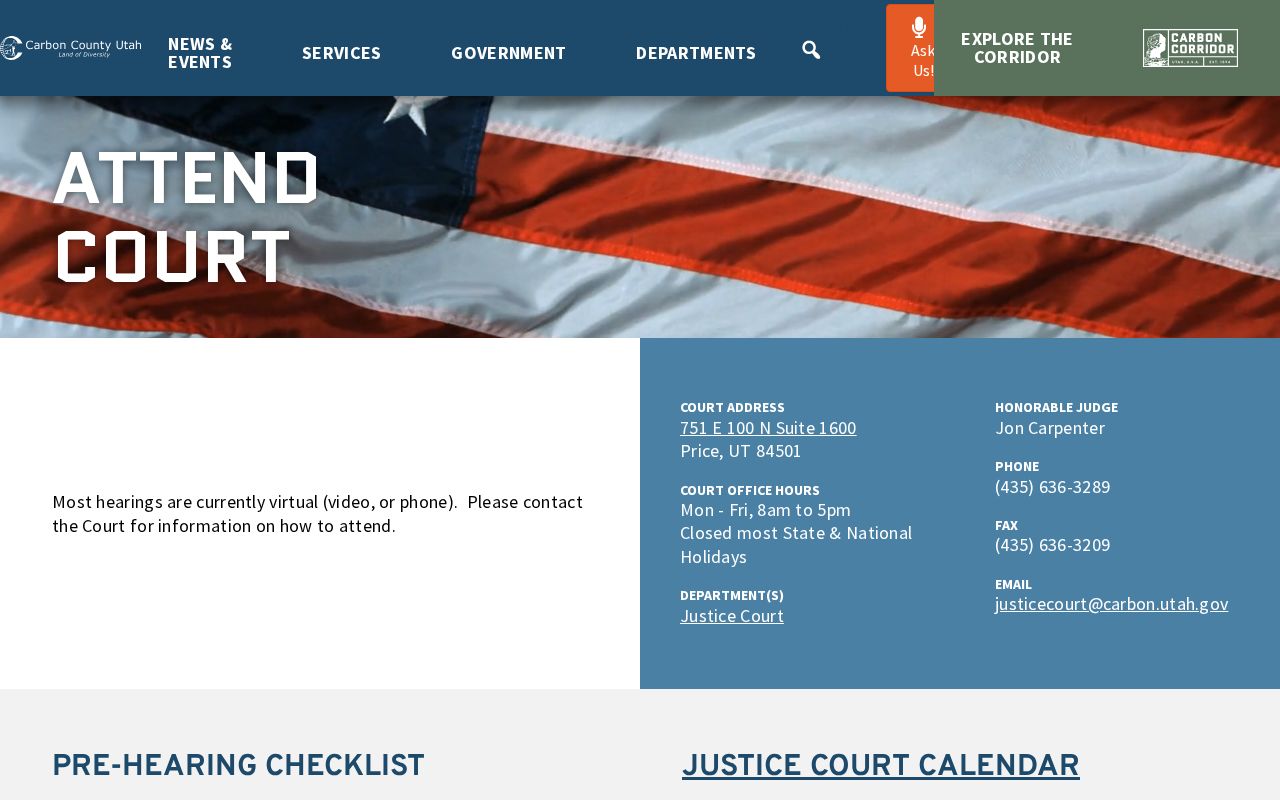
Remote access helps across the broad Seventh District, but it does not change which clerk keeps the Carbon County criminal case record.
Carbon County Discovery Is Different
Public court access, county GRAMA, and criminal discovery serve different roles. A filed public docket may be searched through XChange or inspected through the clerk. A sheriff report can be requested from the creating agency under GRAMA. By contrast, evidence exchanged in a pending prosecution follows Utah criminal procedure. A represented defendant works through counsel. A self-represented defendant contacts the assigned prosecutor.
Carbon County uses JustWare as its e-prosecution and discovery channel. It is not a public case database. County Attorney records may be private, and victim or witness material can be released only as law allows after personal identifiers are removed. Readers seeking the final filed result should return to the court docket rather than treating prosecutor workflow as a public lookup.
Access & Restrictions
Utah Code section 63G-2-201 creates access to public government records, while court records follow the judiciary's own classification rule. Public Carbon County dockets can be viewed through XChange and court counters. Private, protected, sealed, expunged, and juvenile records do not become public merely because the government holds them.
Expunged cases are absent from ordinary public display. Juvenile delinquency files are not listed in XChange. Victim details, personal identifiers, and protected investigative content may also be withheld or redacted. If a known case does not appear, ask the clerk whether the issue is an old paper record, a search mismatch, or an access classification. Staff may explain the channel, but restricted contents stay closed without legal authority.