
How to Check Criminal History in Helper
A useful Helper criminal history check starts by naming the record, not merely the person. Helper Police holds its incident narratives, statements, and arrest reports. Carbon County holds jail custody and the lower-court records that Helper now routes through the shared Justice Court. Seventh District Court keeps felony and class A misdemeanor cases. XChange can connect public court events across Utah, while BCI Right of Access is the route for a person seeking their own fingerprint-linked Utah history.
Bring a full name and date of birth when legally appropriate, plus an incident date, location, report number, citation number, or case number if known. Similar names and non-unique case numbers make the Helper location and court essential checks.
- Ask Helper Police for the incident or arrest record using its government-records form.
- Check Carbon Current Bookings for present county custody, then call the jail if the interface lacks detail.
- Search Carbon County Justice Court or Seventh District Court based on the filed charge level.
- Read each count's plea and disposition instead of treating an arrest allegation as the result.
- Use BCI Right of Access when reviewing your own complete Utah criminal history.
Helper Criminal Record Request Forms
The Helper Police page links several forms that serve different jobs. The Utah Government Records Request is the route for a public-record request. A Citizen Complaint addresses conduct by the department, while a Statement records a witness or involved person's account. Submitting the wrong form can slow the request because a complaint or statement does not itself ask the records custodian to search and release a file.
A focused GRAMA request should identify the police department, describe the record, give a date range, and state the desired delivery method. Add an event location, report number, and names when known and lawful. The indexed form did not establish a Helper-specific fee, identification rule, notarization rule, or every required checkbox. Read the current official form before signing rather than assuming those details.
- Records request
- Asks the city to locate and classify an existing government record.
- Witness statement
- Supplies facts to police; it is not a request for a released report.
- Citizen complaint
- Raises a concern about department conduct through a separate process.
The Helper Police Department
Helper Police Department is at 97 South Main Street, Helper, Utah 84526. Its published phone is 435-472-3719 and fax is 435-472-3514. The department creates the first detailed city record when an officer documents an event. That report may contain the incident number, time and location, narrative, people and property involved, alleged conduct, officer information, and later supplements. GRAMA classification still permits redaction of private identifiers, victim details, information about minors, and protected investigative material.
The city's official police page is the source for its current contacts and form library. It also identifies Chief Sean Draper and links victim resources, the department policy manual, and an approved ALPR permit. The ALPR item documents a city police technology approval; it is not a public plate-search database.
The official Helper Police contact page shows the department's record channels and forms.
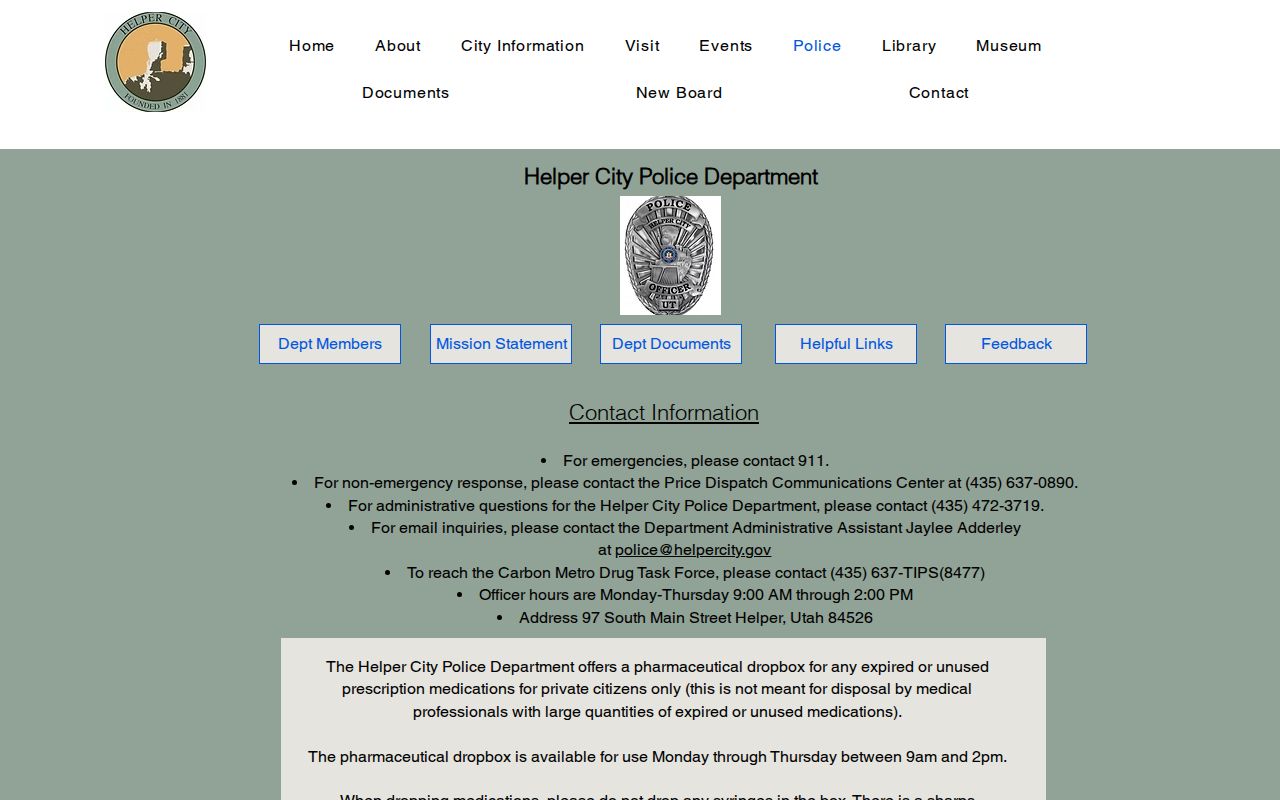
The captured page confirms that a Helper report request begins with the city police custodian rather than a countywide incident database.
Two Helper Record Counters
Helper's small downtown still has a meaningful custodian split. Police records begin at 97 South Main, but broader city administration is at City Hall, 58 South Main. City Hall can be reached at 435-472-5391. General city forms may be delivered as the official documents page directs, but a police narrative remains a police record. Naming the proper office helps the city route a request without turning a broad inquiry into paid research.
Helper Police
97 S Main St
Helper, UT 84526
435-472-3719
Helper City Hall
58 S Main St
Helper, UT 84526
435-472-5391
Call before visiting when a request depends on counter hours or a particular records custodian.
Arrests and Bookings in Helper
Helper has no identified city detention roster. When Helper Police makes an arrest that requires jail booking, Carbon County Jail is the custody channel because the sheriff states that the jail houses people booked by all law-enforcement agencies in the county. The free Current Bookings page is the first place to check current custody. Its listed charges are preliminary, and the accessible official page did not verify common profile fields such as bond, mugshot, booking number, or date of birth.
For more detail, call the jail at 435-636-3254 or request releasable booking material from the sheriff. The arrest narrative stays with Helper Police. Once charges are filed, the court record becomes the better source for pleas, dismissals, judgment, and sentence. The county-wide Carbon County arrest history resource explains that chain in more depth.
If the online roster and jail call do not supply a releasable record, send a focused GRAMA request to the Carbon County Sheriff Business Office. The office accepts direct requests at 240 W Main Street in Price and by email at SheriffsOfficeAdmin@carbon.utah.gov. The county Clerk/Auditor is the broader fallback for submissions by person, mail, email, fax, or the Utah Open Records Portal.
Custody path: Helper Police › Carbon County Jail › handling Carbon court.
Note: A booking allegation can change before filing and never proves that the person was convicted.
Helper History and Record Context
Helper counted 2,112 residents in the 2020 Census. Its name comes from railroad helper engines that assisted trains on the grade toward Soldier Summit. Coal and rail work shaped the town, which now describes itself through identities such as Utah's Christmas Town, an International Dark Sky Community, and a living ghost town. That setting explains why local history and current police records can sit close together while serving very different purposes.
The Helper city-places page records the 2017 move of City Hall into a former Wells Fargo building donated to the city.
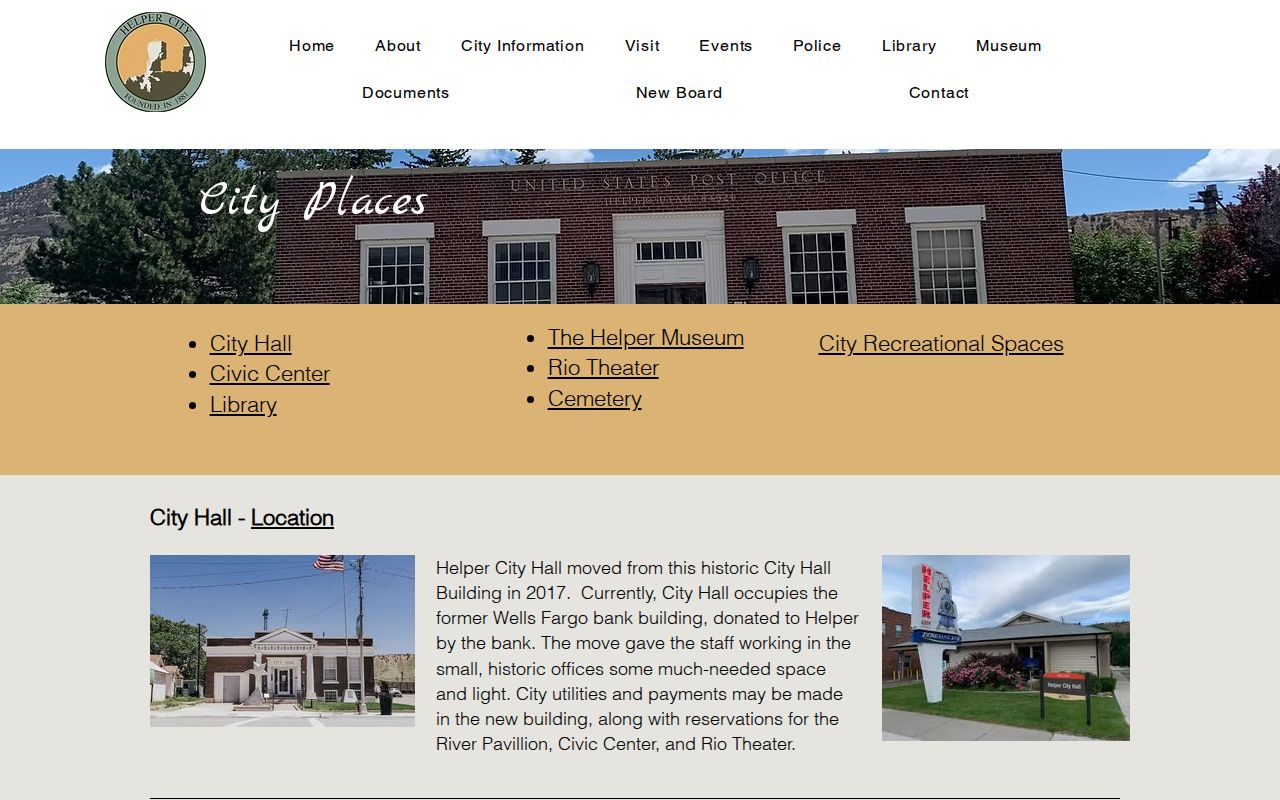
The image anchors Helper's administrative record counter in the city's real Main Street history without confusing that office with the police custodian or county courts.
Helper Municipal Court Records
Current county guidance says Carbon County Justice Court handles Helper class B and class C misdemeanors, infractions, and city ordinance matters. The strongest sources did not confirm a separate active Helper judge or public case-search counter. That means the old assumption that each city has its own searchable court can send a requester to the wrong place. Class A misdemeanors and felonies go to Seventh District Court in Price.
| Court Name | Carbon County Justice Court for Helper lower-level criminal and ordinance matters |
|---|---|
| Case Types Heard | Class B and C misdemeanors, infractions, and Helper ordinances |
| Case Lookup Channel | Utah Courts XChange, courthouse terminal, or the Carbon County Justice Court clerk |
| What the Docket Shows | Filed counts, pleas, events, disposition, sentence, and available public documents |
| Higher Charges | Class A misdemeanors and felonies route to Seventh District Court |
Scope an XChange name search to Carbon County and confirm the court and date of birth when available. A case or citation number is not unique across all Utah courts.
Helper Court Fine Records
Helper still publishes a Pay Court Fines Online channel. It is a payment route, not proof that Helper operates a separate public court database. Confirm the current destination, case location, and amount with the handling court before paying. Utah ePayments may use a case number or citation number, and the user must check the displayed name and court because those identifiers are not statewide unique.
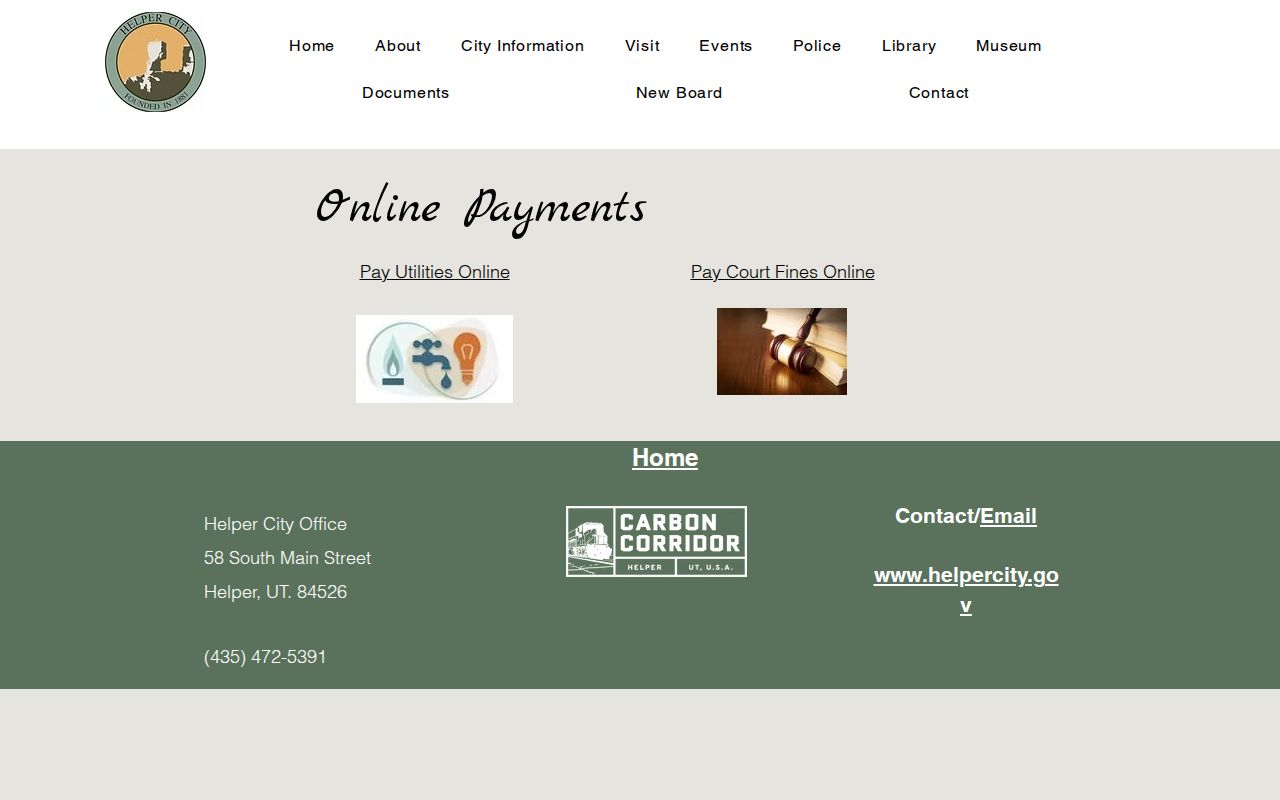
The captured payment page is useful after a case is identified, but it cannot replace the docket when the goal is to read charges or the final disposition.
Contact the court if a delinquency or warrant fee appears. Making a payment does not by itself clear a warrant or replace required appearance instructions.
Where Helper Records End Up
A Helper event can produce several records at different times. The police report exists first with Helper Police. If there is an arrest, Carbon County Jail records intake and current custody. A prosecutor-filed class B or C count becomes a Carbon County Justice Court case, while a class A or felony count becomes a Seventh District case. Fingerprints from a qualifying arrest may enter BCI's statewide pipeline, and the final court disposition should later be reported back.
Record flow: Helper Police › Carbon County Courts › Utah Department of Public Safety, Bureau of Criminal Identification.
These systems are not duplicates. Use the police report for narrative, the jail page for current custody, the court file for adjudication, and BCI Right of Access for your own fingerprint-linked Utah history. A missing item in one system does not prove that no other record exists.
Helper Historical Records Aren't Police Files
The Helper Mining and Railroad Museum preserves a mock mine, jail and smithy, company-store material, school and veterans displays, locomotives, fossils, and evidence of the area's labor and rail past. Those holdings may aid local history or genealogy, but a museum jail exhibit is not a current custody record and an archival name is not a criminal-history match.
For historical research, use the official museum information to distinguish interpretive collections from city administrative archives. For a modern incident, return to Helper Police. For a filed case, use the court. Keeping those categories apart prevents a vivid local-history source from being mistaken for a government justice file.
Reading Helper Criminal Case Results
XChange is Utah's statewide index for district and justice cases. A result can show the Carbon County location, case type and number, filing date, party name, and date of birth when available. The history may add charges and severity, plea and disposition dates, judge, attorneys, prosecutor, law-enforcement agency, chronological proceedings, financial ledgers, and public documents. Remote access is subscription based, while most district courthouses offer free public terminal access.
Read count-level outcomes. A case code such as MO identifies a misdemeanor case type; it does not state that each original allegation led to a conviction. Older files may be sparse, public electronic documents can cost $1 remotely where available, and juvenile or expunged cases are outside ordinary public results.
Note: My Court Case is a party-facing service and should not be treated as a public dossier search.
Public Access Rules
Helper Police and city records are subject to Utah's Government Records Access and Management Act, but GRAMA does not make every fact public. A request must describe the record with reasonable specificity. The city may redact personal identifiers, victim-sensitive material, data about minors, and protected investigative information. Court records follow the judiciary's separate classification rules. UCCH histories remain restricted to the subject and authorized recipients rather than open public name search.
Key Utah rules:
Utah Code § 63G-2-201 creates access to public government records subject to classification.
Utah Code § 63G-2-204 governs specific written requests and agency response handling.
Utah court rule 4-202.02 separates public court files from private, sealed, juvenile, and protected records.
Utah Code § 53-10-108 limits release of the state criminal-history repository.
Ask for the narrow record that answers the question. A precise Helper incident date and report description is more useful than a broad request for everything tied to a name.